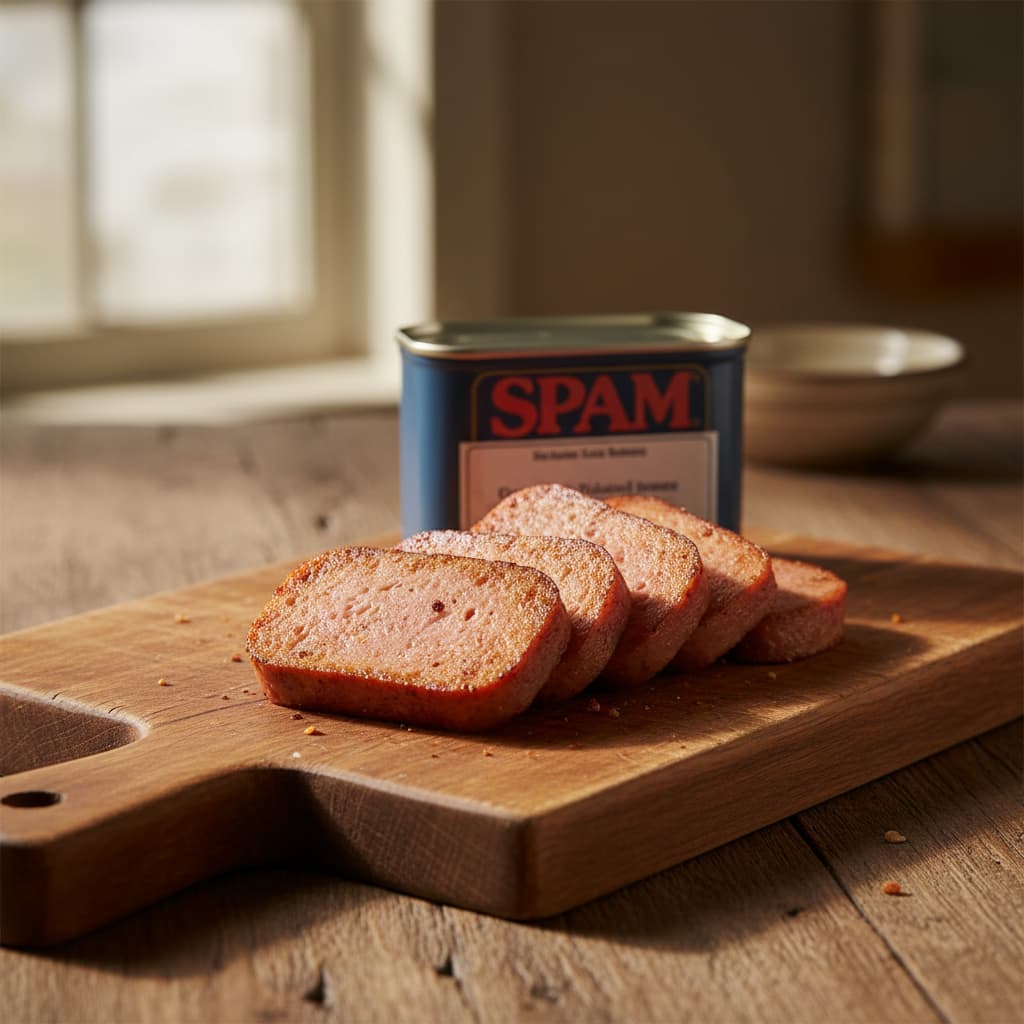
Spam: The Shelf-Stable Meat That Actually Delivers
What it is
Spam is a canned precooked meat product made from pork shoulder, ham, salt, water, modified potato starch, and sodium nitrite. A standard 12 oz can contains about 6 servings. It was introduced by Hormel in 1937 and gained global popularity during World War II when it fed Allied troops across the Pacific. Today it is a staple in Hawaii, South Korea, the Philippines, and pantries worldwide.
Why it belongs in your pantry
Here is the practical case for Spam:
- Fully cooked. Open the can, slice, eat. No cooking required, though it is better pan-fried.
- Calorie-dense. 1,080 calories per 12 oz can. In a food emergency, caloric density matters.
- Shelf-stable meat. Finding shelf-stable protein that actually tastes like meat is difficult. Spam fills that gap.
- Familiar flavor. It tastes like salty ham. Kids eat it. Adults eat it. It works in dozens of recipes.
Yes, it is high in sodium (790mg per serving). That is the trade-off for shelf-stable meat that lasts years. In a situation where you are eating stored food, sodium is not your primary concern. Calories and protein are.
How long it actually lasts
- Unopened, in the pantry: 3-5 years from the production date. Hormel prints a "best by" date typically 3 years out.
- Unopened, past "best by": Generally safe for 1-2 years beyond the printed date. Flavor and texture may decline, but the vacuum seal keeps it safe.
- Opened, refrigerated: 7-10 days, wrapped tightly or in a sealed container.
- Opened, frozen: 2-3 months. Wrap tightly in plastic wrap, then foil.
The key indicator of a bad can is bulging, denting along seams, or off-smell upon opening. If the can is intact and the meat smells like Spam when you open it, it is fine.
How to store it properly
Spam cans are sturdy and stack well. Store in a cool, dry place between 50-70 degrees F. The cans are pull-tab, so keep a can opener nearby as backup in case the tab breaks. Store cans upright. Once opened, transfer leftover Spam to an airtight container in the fridge.
Stacking tip: Spam cans are rectangular, which means they store more efficiently than round cans. You can fit more Spam per cubic foot of shelf space than any round-can meat product.
How to use it
- Pan-fried Spam. Slice into 1/4-inch slabs and fry in a dry pan until crispy on both sides, about 2-3 minutes per side. This is the gold standard preparation.
- Spam musubi. Place a slice of fried Spam on a block of rice, wrap with a strip of nori (seaweed). Hawaii's iconic snack.
- Spam fried rice. Dice Spam into cubes, fry until crispy, then add day-old rice, soy sauce, scrambled eggs, and frozen vegetables.
- Spam and eggs. Slice and fry alongside scrambled or fried eggs. A complete breakfast from pantry staples (powdered eggs work too).
- Spam sandwiches. Pan-fried Spam on white bread with mustard and a slice of cheese. Simple, filling, satisfying.
- Spam mac and cheese. Cube Spam and fold into macaroni and cheese (boxed is fine). The saltiness of the Spam seasons the whole dish.
- Spam in ramen. Slice and lay on top of instant ramen. The hot broth warms the Spam through. This is a real meal, not just a snack.
Cost per calorie
| Product | Price (approx.) | Calories | Cost per 100 cal |
|---|---|---|---|
| Spam Classic (12 oz) | $3.50 | 1,080 | $0.32 |
| Spam Lite (12 oz) | $3.50 | 660 | $0.53 |
| Spam 25% Less Sodium (12 oz) | $3.50 | 1,080 | $0.32 |
| Great Value Luncheon Meat (12 oz) | $2.80 | 1,020 | $0.27 |
At $0.27-0.32 per 100 calories, Spam is competitive with most canned meats. As a protein source, it costs roughly $0.08 per gram of protein, which is on par with canned chicken and less than most canned beef products.
What to buy
Best all-around: Spam Classic (12 oz). The original. Everything else is a variation on this.
For sodium-conscious storage: Spam 25% Less Sodium. Same calories, same protein, 25% less salt. Tastes nearly identical.
Store brands: Walmart's Great Value Luncheon Meat and other store brands are typically 20-30% less per can. The taste difference is minimal. Worth trying.
Varieties to skip for storage: Spam with Bacon, Spam Teriyaki, and other flavored varieties are fine but cost the same for less versatility. Stock the classic and add your own flavors.
Frequently asked questions
Is Spam bad for you? Spam is a processed meat product that is high in sodium and saturated fat. For everyday eating, moderation makes sense. For emergency food storage, those concerns take a backseat to caloric density, shelf life, and palatability. It is a practical food, not a health food.
What is actually in Spam? Six ingredients: pork with ham, salt, water, modified potato starch, sugar, and sodium nitrite. That is it. The ingredient list is shorter than most "healthy" snack bars.
Can I eat Spam straight from the can? Yes. It is fully cooked during canning. Many people prefer it cold, sliced thin. Most people prefer it pan-fried for the crispy edges. Both are fine.
Why is Spam so popular in Hawaii? During World War II, Spam was a primary ration for troops stationed in the Pacific. It became deeply embedded in Hawaiian, Filipino, Korean, and Japanese food culture. Hawaii consumes more Spam per capita than any other state, about 7 million cans per year.