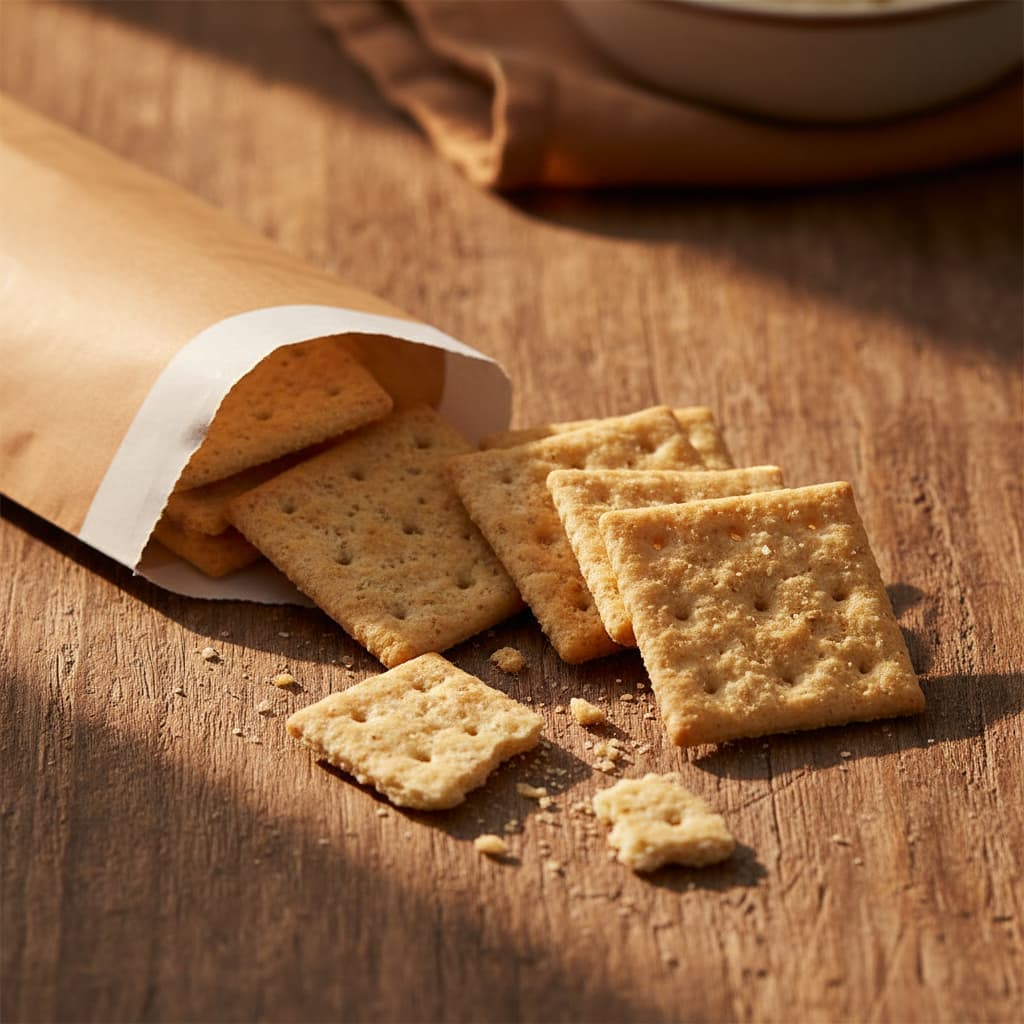
Saltine Crackers: The Underappreciated Pantry Staple
What it is
Saltine crackers (also called soda crackers) are thin, crispy, square crackers made from white flour, baking soda, yeast, and salt. They are intentionally bland and lightly salted, designed to be a vehicle for other foods rather than a standalone snack. A standard box contains 4 sleeves of about 40 crackers each. Five crackers is one serving at 70 calories.
Why it belongs in your pantry
Saltines serve a specific and critical role in pantry food: they make everything else more edible.
- Platform for proteins. Canned tuna, sardines, peanut butter, and cheese all become actual meals when served on crackers instead of eaten with a fork from a can.
- Bread substitute. When bread goes stale in 3-5 days, crackers last months. They fill the "carb base" role in no-cook meals.
- Soup companion. Crackers in soup stretch the meal and add satisfying crunch. Every can of soup improves with a sleeve of saltines on the side.
- Comfort food. Saltines with butter, saltines with peanut butter, saltines in milk (yes, that is a thing). Simple, familiar, calming food.
- Stomach settler. The classic remedy for nausea, motion sickness, and upset stomachs. Doctors still recommend them.
How long it actually lasts
- Unopened sleeve, pantry: 6-9 months past the "best by" date. The inner wax paper sleeves protect against moisture and staleness.
- Opened sleeve, pantry: 2-4 weeks if resealed tightly. They go stale (soft and chewy) long before they go bad (unsafe).
- Stale crackers: Still safe to eat. You can refresh stale crackers by spreading them on a baking sheet and heating at 300 degrees F for 5 minutes.
Saltines don't "go bad" in a food safety sense for a very long time. They go stale, which is a quality issue, not a safety issue. Stale saltines are still fine in soup, crushed as a breading, or as a topping.
How to store it properly
The enemies of crackers are moisture and air. The wax paper inner sleeve is your first line of defense. Leave crackers in the sleeve until you need them, and fold the sleeve tightly closed after opening.
After opening: Transfer to an airtight container or resealable bag. A gallon zip-top bag works. Squeeze out as much air as possible before sealing.
For longer storage: Unopened boxes in a cool, dry pantry. Do not store in the fridge (moisture) or near the stove (heat). Crackers stored in a temperature-controlled pantry at 65-70 degrees F will hit the 9-month mark easily.
Can you freeze crackers? Yes, actually. Frozen saltines last 6+ months with no quality loss. Thaw at room temperature for 30 minutes. They come back crispy. This is a useful trick if you find a deal and want to stock up.
How to use it
- Tuna and crackers. The quintessential pantry snack/meal. Drain tuna, fork onto crackers, add hot sauce.
- Peanut butter crackers. Spread PB on saltines for a quick 200+ calorie snack. Add honey for extra flavor.
- Soup crackers. Crush into tomato soup, chicken noodle, or any broth-based soup. Adds body and makes the soup more filling.
- Cracker breading. Crush saltines in a zip-top bag and use as breading for pan-fried spam patties, tuna patties, or canned chicken. Works as well as breadcrumbs.
- Cracker casserole topping. Crush and mix with melted butter. Spread on top of any casserole before baking. Creates a golden, crunchy top layer.
- Cheese and crackers. Shelf-stable cheese (Velveeta, cheese spread, parmesan) on saltines. A legitimate snack plate from the pantry.
- Saltine toffee (Christmas crack). Line saltines on a baking sheet, pour boiled butter-sugar mixture over them, top with chocolate chips. A pantry dessert that disappears instantly.
Cost per calorie
| Brand | Price (approx.) | Calories | Cost per 100 cal |
|---|---|---|---|
| Store brand (16 oz box) | $2.00 | 2,240 | $0.09 |
| Premium/Nabisco (16 oz box) | $3.50 | 2,240 | $0.16 |
| Store brand (bulk/case) | $8.00 / 4 boxes | 8,960 | $0.09 |
Saltines are not calorie-dense per ounce compared to rice or beans, but they cost very little and serve a role that nothing else fills in a pantry: the ready-to-eat carb base that needs zero preparation.
What to buy
Best value: Store-brand saltines. There is genuinely minimal difference between Premium/Nabisco and store-brand saltines. They are the same product.
Stock: 2-4 boxes per person as a rotating pantry item. Use and replace rather than long-term storage.
Alternatives worth having: Ritz-style butter crackers (shorter shelf life but higher calorie density), graham crackers (pantry dessert base), and Triscuits (whole grain, denser, last just as long).
Watch for: Sales and coupons. Saltines frequently go on sale for $1.50-2.00 per box. That is the time to buy 6-8 boxes.
Frequently asked questions
Are stale saltines safe to eat? Yes. Stale means they have absorbed moisture and lost their crispness. They are not unsafe. Refresh in a 300 degree F oven for 5 minutes or use in recipes where texture does not matter (soup, breading, casserole topping).
Why do saltines come in wax paper sleeves? The inner sleeve is a moisture barrier. Once you break that seal, the clock starts on staleness. Open only the sleeve you are currently eating from. Leave the others sealed.
Can I store saltines long-term like rice and beans? Not really. The fats in crackers go rancid over time, even in sealed containers. Saltines are a rotating pantry item: buy, eat within 6-9 months, replace. They are not a 5-year storage food.
Are saltines just white bread in cracker form? Nutritionally, pretty much. They are made from enriched white flour, same as white bread. Their value is shelf life, convenience, and versatility, not nutrition. Pair them with protein and fat sources for a balanced snack.